


10 min read · delta-dunarii
What to Bring to the Danube Delta: Useful Packing
What to bring to the Danube Delta, without unnecessary things: clothes, footwear, mosquitoes, sun, kayak, and what is already at the guesthouse.
- #delta-dunarii
- #bagaj
- #caiac
- #somova
When someone comes to us for the first time, at Laguna Nuferilor, the question is not only how many nights they will stay. Very often, a short message arrives first: “What should I bring to the Delta?” There is a very practical concern in the question. Not to miss anything important, but also not to carry half the house for two or three days.
Somova is not the end of the world. We are about 10 km west of Tulcea, on an asphalt road all the way to the gate, on a hill above the Somova–Parcheș lake complex. But the place behaves differently from the city: there is a lot of water, reeds, open sun on the canal, misty mornings, and evenings when mosquitoes appear quickly if you sit close to vegetation.
A good bag for the Danube Delta is not a large one. It is packed with water, light, and season in mind. If you come for kayaking, birding, a quiet weekend, or simply to sit on the terrace and look at the lakes, you need light things, quick-drying things, and things that are easy to take out of your bag.
The short list
If you want the version without explanations, start here. For a spring, summer, or early autumn weekend, the basic bag looks something like this:
- a brimmed hat or a good cap, for sunny hours on the water;
- sunglasses, ideally polarized, because they reduce reflection from the canal;
- sun cream, applied before you go out on the water;
- mosquito repellent with about 30% DEET, especially for clothes;
- a thin long-sleeved top and light trousers for the evening;
- water sandals or slippers that can get wet;
- a bottle of water for the road and before departure;
- phone, documents, and keys kept in a dry bag when you are on the water;
- a thin layer for the morning or evening on the terrace;
- 8x42 binoculars, if you are interested in birds.
The rest depends on what you plan to do. If you go out by kayak, footwear and sun protection matter. If you come for birds, binoculars and clothing colors matter. If you come in winter, the story changes: you need a thermal layer, a hat, and clothes that are good for being outside after the hot tub.
Day Clothes
During the day, in the warm season, light clothes work best, the kind that dry quickly and do not hold heat against the skin. On the water, you do not have the shade you have in a garden. The canal seems gentle, but the light comes back from the water, and after two hours you feel the sun on your neck and shoulders.
A thin, light-colored, long-sleeved shirt can be better than a sleeveless T-shirt. It covers you from the sun, does not make you too hot, and works well in the evening too, when mosquitoes appear. For trousers, choose something light, not thick jeans. If they get wet while getting into the kayak, jeans stay heavy and cold.
A brimmed hat is one of the pieces that really does its job here. It is not for photos, it is for the hours when you sit facing the water and cannot find shade. A cap is good, but a hat protects your ears and neck better. Add polarized sunglasses if you have them. On lakes and canals, the difference is clear: reflection drops and your eyes tire less quickly.
Evening and Mosquitoes
Mosquitoes are part of the Delta’s reality. Not all year and not the same every day, but between May and September they appear often enough that it is worth coming prepared. The peak is usually in July and August. Evening is the most intense, especially near reeds and water.
We tell guests the same thing: mosquito repellent with about 30% DEET, applied especially to clothes, plus long sleeves in the evening. Citronella bracelets can help as an extra layer, but I would not pack them alone if you know you are sensitive to bites.
For the evening terrace, put a thin garment in your bag. We are not talking about serious cold in July, but about the coolness that settles over the lakes after sunset, when the light falls slowly and birds can be heard from the water. On misty mornings, the same garment is useful for coffee too.
If you come as two and want to keep the bag as simple as possible, here is a list closer to the rhythm of a short stay: what to bring for a weekend for two.
Footwear
In the Delta, the wrong footwear gets in your way faster than a forgotten item of clothing. For kayaking and shores, water sandals or slippers that can get wet work well. Getting into the kayak may mean placing a sole in water, stepping in mud, or touching a wet edge. It is normal.
Mountain boots do not make much sense here. They are heavy, hold heat, dry slowly, and do not help you on the water. It is better to have a light pair for the day and something comfortable for the guesthouse. If you are planning the Somova–Parcheș kayak route, we explain separately what to wear on the water on the kayak route.
For children or adults who have not been in a kayak before, the practical rule is simple: everything you wear on the lower half should be able to handle a few splashes. It does not mean you will end up wet from head to toe. It only means the water is close and does not sit quietly at the edge.
On the Kayak
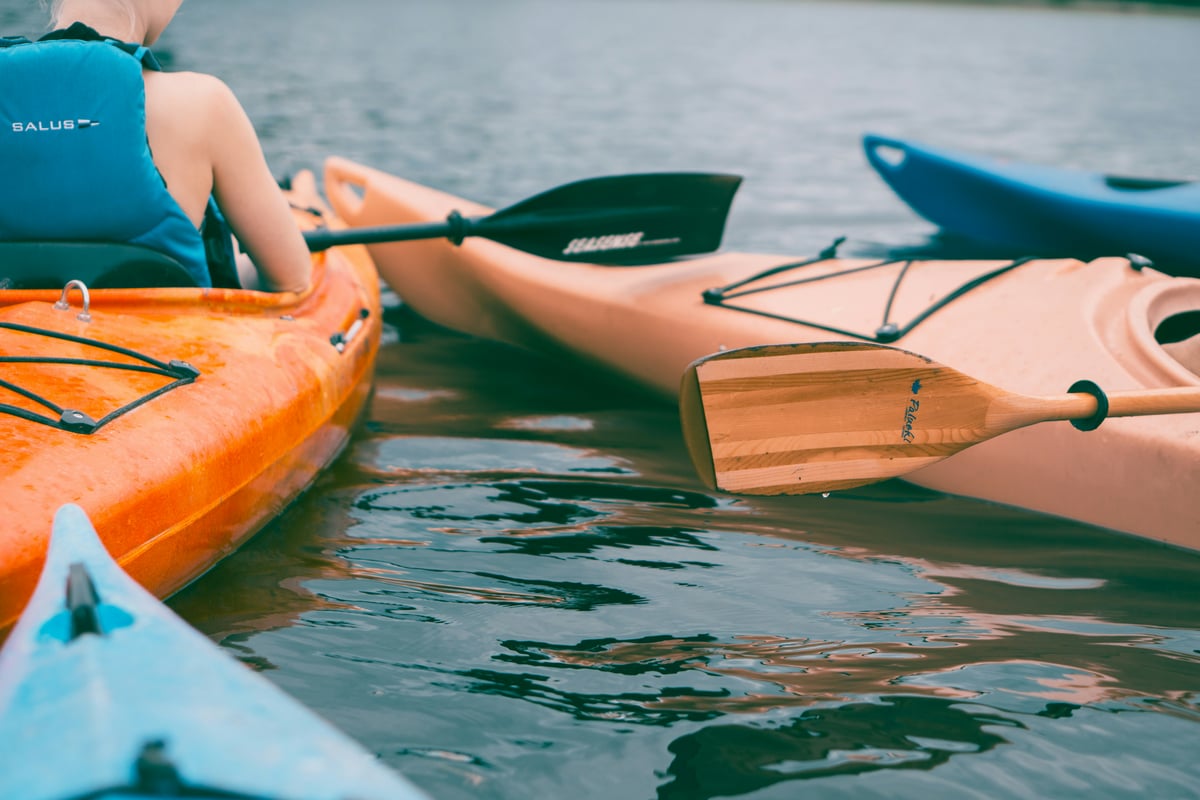
If you come for kayaking, do not fill the car with gear you already receive here. With the kayak rental, the life jacket and paddle are included. For your phone, keys, and documents, a 5L dry bag is included. You can find the details on the page about what you receive in the kayak kit.
Our kayaks are single kayaks. This means each adult paddles in their own kayak. A child goes out on the water only if they can handle a single kayak by themselves; otherwise, a boat trip is the more suitable option. For a double kayak, an external partner can be used, but we do not treat it as our basic product.
The phone works along much of the route. 4G coverage is around 80%, but on the water that is not the main concern. The concern is where you keep it. In a pocket, one careless paddle stroke or a clumsy entry into the kayak can reach it immediately. In the dry bag, it sits quietly.
What you bring yourself: polarized sunglasses, a hat, water drunk before departure, and clothes suited to the sun. There is no shop on the kayak route, and the toilet and water are handled at the guesthouse before you leave. It is more pleasant to set off without improvising.
For Birds
If you come with birds in mind, 8x42 binoculars are enough for what you can see from here. You do not need complicated equipment to enjoy the mornings in Somova. In the first hours, when the mist still lies over the water, you see movement on the lakes and in the reeds differently.
Clothes matter too. Green, khaki, brown, and muted greys are better than white, red, or strong colors. Not because birds read the fashion catalogue, but because movement and contrast show quickly in an open place. We added more details in the article about which binoculars and which colors to wear for birding.
If you do not have binoculars, I would not rush to buy the largest model found online. A good 8x42 pair, held steady in the hand, is more useful than heavy binoculars you leave in the room after the first outing.
What You Already Have Here
A good part of your bag can stay at home. In the rooms you have free Wi-Fi, air conditioning, a mini-fridge, an 81 cm SmartTV, a private bathroom, a hair dryer, and towels. If you want to check by room, here is the page with what you already find in the room.
Laguna Nuferilor is a family guesthouse, not a large hotel. We do not have a restaurant, spa, or concierge. Breakfast is optional extra and can be added to the stay. For lunch or dinner, you look toward Tulcea, Mahmudia, or other stops in the area, depending on the day’s route.
With us you have free video-monitored parking, a garden, a grill with pergola/gazebo, a hot tub, and a fishing place down by the shore. In Somova you are close to Tulcea, but it is still good to think through your bag for the day: what you take with you in the morning should be what you use until you return. For general orientation, the main page shows what is close at hand in Somova.
What to Leave at Home
I would leave at home thick city clothes in high summer, shoes that cannot handle dust or water, heavy perfumes for evenings near the reeds, and rigid bags for outings on the water. In the Delta, simple things work better: a soft bag, clothes that wash easily, footwear that does not need apologies after every step.
Do not bring a kayak life jacket, do not bring a paddle, and do not rely on the idea that you will find something to buy on the route. For the water outing, we cover the basic gear, and you come with your personal things: sun protection, sunglasses, hat, and suitable clothes.
I would also leave at home the bag packed for the mountains. The Delta does not ask for stiff boots, thick fleece, and a heavy backpack, unless you come in winter. In the warm season, water and sun decide more than the ground.
By Season
In May and June, the days can be very pleasant, but long sleeves are worth having in the evening. Mosquitoes begin to matter, especially near reeds. In July and August, sun protection and mosquito repellent are the first things on the list. That is when you feel most clearly the sun from the water and the lively evenings near the lake.
In September, the bag becomes a little calmer, but do not remove the mosquito spray completely. The light becomes gentler, and mornings may ask for a thin garment. For sitting on the hill before the mist lifts, binoculars, coffee, and something over your shoulders are often enough. We wrote separately about the view from here, in the article about the hill at Somova and the Delta lakes.
In winter, the list is different. If you come for quiet, the hot tub, and the view over the water, pack a thermal layer, a hat, and good clothes for going outside after sunset. There is not the movement of the warm season, there are not the same insects, but the cold gets in quickly if you sit still on the terrace.
A Good Bag
Packing for the Danube Delta does not need much theory. Look at your day: you go on the water, sit in the sun, return in the evening near the lakes, maybe wake early for birds. For each moment you need a few clear things, not a long list.
If you arrive to us with a hat, sunglasses, mosquito repellent, light clothes, footwear that can get wet, and a thin garment for evening, you are already almost set. The rest is adjusted by season and by what you want to do in the 2 nights or more spent here.
For availability and choosing a room, go to what you already find in the room. Rooms 5 and 6 have panoramic views, rooms 3 and 4 partial views, and rooms 1 and 2 have a terrace. Check-in is from 14:00, check-out at 11:00.
Frequently asked questions
- What clothes should I bring to the Danube Delta?
- During the day, light clothes that dry quickly work well, plus a brimmed hat and sun protection. In the evening, long sleeves help both with the coolness near the water and with mosquitoes.
- How do I protect myself from mosquitoes in the Delta?
- Mosquito season is May to September, with a peak in July and August. A spray with about 30% DEET applied to clothes, long sleeves in the evening, and possibly citronella bracelets are a practical combination.
- What footwear is good for the Delta?
- Water sandals or slippers that can get wet are the most useful for kayaking and the shore. Mountain boots are too heavy for water, reeds, and warm days.
- Do I bring a life jacket and dry bag for kayaking?
- No. With the kayak rental you receive a life jacket, paddle, and a 5L dry bag for your phone, keys, and documents.
- Does the phone work on the water?
- Yes, 4G coverage is around 80% on the kayak route. Even so, the phone is best kept in the dry bag, not in your pocket.
- What should I bring if I want to see birds?
- 8x42 binoculars are a good choice for observing birds in the Somova–Parcheș area. Clothes in green, khaki, brown, or muted grey are more suitable than white or very bright colors.
- What do I not need to bother bringing?
- In the rooms you have free Wi-Fi, air conditioning, a mini-fridge, an 81 cm SmartTV, a hair dryer, and towels. For kayaking, the life jacket, paddle, and 5L dry bag are included in the kit.