


10 min read · birding-delta
Birdwatching in the Danube Delta, seen from Somova
A calm guide to birdwatching in Somova: what you can see from the terrace, by kayak, and on longer outings into the Delta.
- #birding-delta
- #pasari-somova
- #delta-dunarii
- #somova
When people look for a birdwatching place in the Danube Delta, they usually imagine a pontoon hidden in the reeds, a boat leaving before sunrise, or a long list of species ticked off in a notebook. In Somova, things begin more simply. You stand on the hill, above the Somova–Parcheș lake complex, 10 km west of Tulcea, and you see the water before you reach it.
We live with this view every day. In the morning, before the mist lifts, birds can be heard from Parcheș and small movements appear along the edge of the reeds. Sometimes it is a little egret (Egretta garzetta), white and quick, other times a heron passing low, close to the surface of the water. You do not need to set off straight away chasing rare sightings. The first half hour can be spent quietly, binoculars to your eyes, right from the terrace.
The Delta has more than 360 documented bird species, and there are guides, atlases, and specialist tours for that. This article does not try to put them all into one list. I would rather tell you what is worth watching from Somova, by kayak, from the nearby channels, and on a few longer outings, if you come to Laguna Nuferilor with the idea of setting aside 3 mornings for birds.
Why Somova
Somova is not in the heart of the channel maze, and that is exactly what makes it good for a birder who wants rhythm, not rushing around. You are close to Tulcea, the road to the gate is paved, and the Somova–Parcheș lakes sit below the hill, in plain sight. You do not head blindly into the Delta. First you look at the light, the wind, the places where birds are moving, then you choose whether to go out on the water, head towards Mahmudia, or make a longer day to the south.
The hilltop view is our easiest birdwatching point: from the terrace, with 8×42 binoculars, you can catch the herons without going down to the water. We wrote separately about the view from the hill towards Somova and the Danube Delta, because it changes the way you start your mornings here.
For anyone looking for birds in Somova, the advantage is that you do not lose the first hour in the car. You wake up, step outside, and listen. If you have installed Merlin Bird ID before you leave, you can let it run for a few minutes to catch the morning sounds. It does not replace the eye, but it helps you separate the background noise from something worth following.
The first hour
The best part of the day is between sunrise and the moment when the air warms properly. In May and June, birds are active early because it is nesting season. In September, migration brings a different kind of movement: flocks that appear, disappear, settle for a short while, then move on. July and August can be beautiful, but at noon many birds withdraw and the light becomes harsh.
Here, a good morning starts without hurry. Coffee can wait 10 minutes. Step outside, do not talk much, and scan the edge of the water and the reeds. The little egret (Egretta garzetta) is easy to see on channels and in low areas. The purple heron (Ardea purpurea) asks for more patience; you look for it especially from May to August, in the reeds, very early in the morning, when it moves slowly and seems to dissolve into the colour of the place.
If you stay in Room 5, a 23 m² triple room with a panoramic view, you have a very good angle towards the water. Room 6 also has a panoramic view. For a couple or a family coming with binoculars and a camera, the room with a direct lake view changes the way the stay feels: you do not wait for the tour to see birds, you look for them between outings too.
From the kayak
The kayak is good for birding because it does not push noise ahead of you. You do not go near colonies, you do not move in on the birds, but you can advance slowly beside the reeds, without a motor, with frequent pauses. From the kayak, the herons look different: lower, closer to water level, with their reflection beside you.
At Laguna Nuferilor we have single kayaks, with life jacket and paddle included. Rental is by time interval: 0–3h = 60 RON, 3–6h = 90 RON, and the full day = 120 RON. For birds, the 3–6h interval is the most suitable, because it leaves you time to enter slowly, wait, and return without rushing. More details are on the kayak rental page, where we also explain how to choose the duration.
Important: the kayaks are single. We do not have double kayaks, so you cannot put a small child in the same kayak with an adult. If the child can paddle alone and keep direction, the route can be discussed. If not, the boat tour is the better option. For birding with children, two hours is usually enough: after that, patience drops, and birds cannot be hurried.
Nearby species
Around Somova, you should not expect the same density of sightings as on a long day on Furtuna or in colony areas. But this is exactly where you learn the rhythm of the place. The little egret (Egretta garzetta) appears often on the channels. The purple heron (Ardea purpurea) is looked for in the reeds, especially in the morning. The pygmy cormorant (Microcarbo pygmaeus), a protected species, can be seen better on tours towards Lake Furtuna, but it is worth keeping in mind when you notice small, dark silhouettes close to the water.
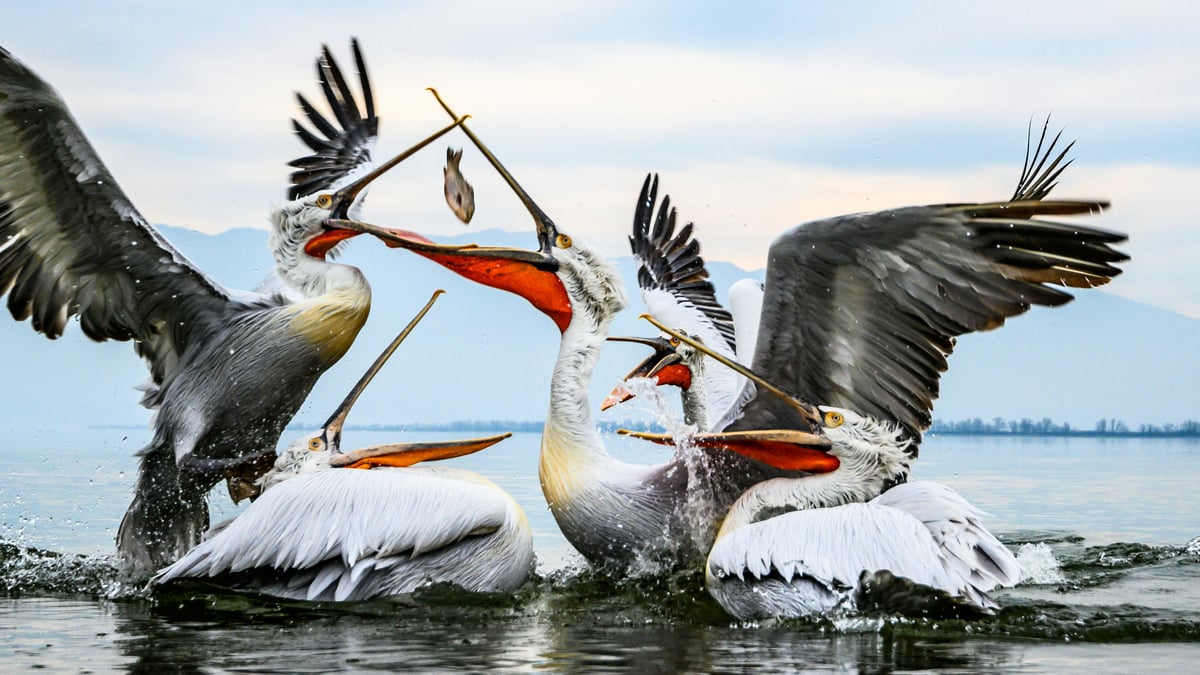
The great white pelican (Pelecanus onocrotalus) is the bird many people have in mind before they arrive here. It is best seen between April and September, and the colonies on Furtuna and Hrecisca are known reference points for dedicated tours. We do not turn it into a promise, because nature does not work by our schedule, but in season you have good chances of seeing it in flight or on the water.
The white-tailed eagle (Haliaeetus albicilla) is another presence that immediately changes the attention in the boat. In summer it is seen fairly often in areas such as Letea and Caraorman. When it appears, nobody speaks for a few seconds. You follow it through the binoculars and understand why birdwatching in the Danube Delta is not only about many species, but also about a few encounters that are worth staying still for.
Places to go
If you have 3 nights in Somova, I would divide the birding into three different mornings. The first stays local: terrace, the Somova–Parcheș lakes, perhaps kayak. The second can be a boat tour in the Delta, with the route chosen together and added to the booking. The third can be a longer outing, depending on the season and what you want to look for.
Lake Furtuna remains one of the large places for birds. From Mahmudia, a tour there takes time, but it is worth it if you want great white pelicans (Pelecanus onocrotalus), pygmy cormorants (Microcarbo pygmaeus), and Eurasian spoonbills (Platalea leucorodia). With 8×42 binoculars, you do not need to go close to the colonies. Stay at a distance, follow the movement on the willows, watch the birds coming and going.
Lake Belciug has a quieter rhythm and is good for patient observation. You do not come here only for a photograph, but for an hour of looking at the edges: reeds, open water, birds changing place according to the light. Dunavăț is another suitable area for channels and reedbeds, especially when you want to combine a Delta day with observations without staying only in the boat.
Letea and Mila 23 are for longer days. Letea comes into the discussion when you are looking for white-tailed eagle (Haliaeetus albicilla) and when you want an experience deeper into the Delta itself. Mila 23 has another rhythm, a village held between waters, and can be good on a tour where birds are only half the story. For someone coming for the first time, I would put these places after you have understood Somova and the lakes beside us.
The second visit
I see the Razim–Sinoie lake complex as an extension for a second visit, not as something necessary on the first stay. It lies to the south, beyond Murighiol, and becomes interesting especially during migration, when birds move across large stretches of water and open areas. The advantage is clearer access by car compared with some inner channels.
For September, Razim–Sinoie can be a very good day if you have already built up your patience. You do not go there to tick things off quickly, but to scan. A spotting scope would help, but 8×42 binoculars remain enough for many observations. If this is your first birding outing, I would still start with what is closer: Somova, Furtuna, and the channels where the local guide knows the right entrances.
In a 3-day itinerary in the Danube Delta, the day dedicated to birds should be placed early, not at the end, when you are already tired. And if you come as two, without a loaded schedule, a very good morning can also be early on Lake Somova-Parcheș, with a thermos, binoculars, and long pauses.
What to bring
To start with, 8×42 binoculars are enough. More does not necessarily mean better, especially if you carry them for 4–5 hours. What matters is that you can hold them steady, lift them quickly to your eyes, and not have a sore neck after the first tour. If you already have a pair, bring that one. If not, look for something bright and comfortable, not the largest number on the box.
- Clothes in green, khaki, or brown; avoid yellow, red, and pure white, which stand out strongly in the landscape.
- Long trousers even in summer, for mosquitoes and for areas with reeds.
- A brimmed hat, water, and sun protection, especially after 10:00.
- Merlin Bird ID installed before departure, with the Eastern Europe pack downloaded offline.
- eBird, if you want to keep your observation list and see useful maps.
The phone helps, but do not let it lead the day. Sometimes the app says something interesting, and the bird does not show itself. Other times you see an egret, a heron, or a pelican very clearly and you do not need digital confirmation. The best mornings are a mix of listening, watching, and checking only at the end.
With a guide or alone
For a first visit, a local guide helps a lot. Not because you could not manage at all on your own, but because the Delta has entrances, channels, distances, and habits that you do not learn from a map. A boat tour can be added to the booking, with the route chosen together, depending on the season and what you want to see.
After the first tour, you begin to understand the place better. You know what a colony seen from a distance means, what the right reeds for purple heron look like, where it is worth stopping the kayak, and when the light becomes too harsh. From there, you can return to the water on your own, especially on routes close to Somova.
Photography asks for even more patience than observation. Do not force closeness. Sometimes the good frame is a small bird in a large landscape, not the plumage filling the screen. For inspiration, you can see a few photographs from the channels, but in the field it is worth putting the camera down now and then and watching only through the binoculars.
How I would arrange the stay
For birding, 3 nights are better than one or two. On the first evening you arrive, check-in after 14:00, step out onto the terrace, and look at the water. The next day you catch the first full morning. On the third day you already have a reference point: you know how the light falls, what you have seen, what you want to look for next. On the last morning you still have a short chance before check-out at 11:00.
At Laguna Nuferilor, accommodation starts from 280 RON per night for double rooms and 360 RON per night for triple rooms. Breakfast is an optional extra, 75 RON / person / night. We do not have a restaurant, spa, or concierge; we are a family guesthouse, with free video-monitored parking, a garden, a hot tub, and places to sit outside after a tour.
If you come for birds, tell us when you book. Not so we can promise species, but so we can arrange the days better: one morning on the terrace and on Somova–Parcheș, one by boat, one perhaps by kayak or with an outing towards wider areas. Birds cannot be ordered, but time can be arranged in your favour.
Frequently asked questions
- What binoculars should I use for birds in the Danube Delta?
- An 8×42 pair is enough for what you see from Somova, from the kayak, and from the boat. It is more important for them to be comfortable and bright than large and heavy. If you can hold them steady for a few minutes, you will see more.
- What is the best season for birding in the Danube Delta?
- May and June are very good for nesting, with birds active in the morning. September is good for migration, when flock movements and different observations appear. July and August can be hot, and after noon birds often withdraw.
- When can I see pelicans in the Danube Delta?
- The great white pelican (Pelecanus onocrotalus) is best seen between April and September. The colonies on Furtuna and Hrecisca are good reference points on dedicated tours. It is not guaranteed, but in season the chances are good.
- Can I see white-tailed eagle in the Danube Delta?
- Yes, the white-tailed eagle (Haliaeetus albicilla) is seen during summer, especially in areas such as Letea and Caraorman. For a first visit, it is best to look for it on a tour with a local guide. Appearances are short, so keeping the binoculars close matters.
- Is Merlin Bird ID worth using for Somova?
- Yes. Merlin Bird ID is free and helps a lot with sound identification, especially in the morning. Install the Eastern Europe pack beforehand, so you can use it offline.
- Do I need a guide for birdwatching near Tulcea?
- For the first tour, yes, a local guide shortens the trial and error a lot. They know the channel entrances, the right distances from colonies, and the places where it is worth stopping the boat. After the first outing, you can orient yourself better on your own, including by kayak.
- Can I go birding with children?
- Yes, but keep the tour short, around 2 hours. Choose the morning, when it is cooler and the birds are more active. If the children cannot paddle alone in a single kayak, the boat tour is the more suitable option.